


















Let’s work together to find a solution
Rely on AVANA Capital to help preserve your wealth and create growth for your business.

The best bridge loan lenders in Indiana come with a catch: the state is home to one of the country’s largest multifamily and healthcare bridge lenders, and most Indiana commercial borrowers cannot use it. That operation runs institutional-scale securitisations in two specific asset classes. If you own a retail centre in Evansville, a hotel in Indianapolis or a logistics building in Fort Wayne, Indiana’s biggest bridge lender is not your lender — and what remains is a bench built largely for residential investors.
This guide covers commercial bridge financing in Indiana — industrial, retail, hospitality, mixed-use and adaptive reuse, generally $1 million and up.
You are a homeowner buying before you sell. You need residential or consumer bridge financing from a mortgage lender, bank or credit union. Nothing below applies.
You are flipping houses or buying single-family rentals. Indiana is well served. Unitas Funding and CPL Investments lend to Indiana investors directly, Bridgewell Capital serves Indianapolis, and national platforms including Lima One Capital (minimum $75,000) and Easy Street Capital are purpose-built for residential investment property. Indiana’s low basis means many real deals belong here.
You own or are buying income-producing Indiana commercial property — an Indianapolis adaptive-reuse or hotel project, a logistics building in lease-up, a retail centre mid-repositioning — and you need short-term capital until the asset supports permanent debt. This page is for you, and it is where Indiana’s bench is thinnest relative to demand.
For how the flavours of private capital differ, see our guide to hard money versus private money lenders.
AVANA Capital is a direct commercial real estate lender — not a broker or a marketplace — with $1.7 billion in loans closed over 23+ years and lending coverage in all 50 states. Its bridge program is backed by a joint venture with Oaktree Capital — institutional capital behind the loan.
The Indiana-relevant point is breadth of asset class. Where the state’s largest bridge platform is purpose-built for two property types, AVANA lends across hospitality, industrial, retail and other special-purpose assets — which is exactly the gap Indiana’s specialised capacity leaves open. Loans run $5 million to $30 million, and there is no footprint or membership test, so Fort Wayne, Evansville and South Bend reach the same credit team as Indianapolis. AVANA-financed projects have supported 5,000+ jobs created in the USA.
Best fit: Indiana commercial bridge $5M–$30M, hospitality and adaptive reuse, industrial lease-up, special-purpose property, out-of-state sponsors.
Unitas Funding is an Indiana hard money lender providing real estate investor loans across the state, ranking consistently in Indiana hard-money search results.
Best fit: Indiana investor deals, weighted toward residential and smaller transactions. Confirm current loan ranges and whether commercial income-producing property is in appetite.
CPL Investments is an Indiana-based hard money lender serving local real estate investors on acquisition and renovation projects.
Best fit: Indiana investor deals with a local lender. Verify loan range, leverage and commercial appetite directly — published parameters are thinner than the lenders above.
Bridgewell Capital is a private lender serving Indianapolis investors with fix-and-flip and hard money loans, focused on residential investment property.
Best fit: Indianapolis-area residential investor deals. Included because it ranks prominently for Indiana hard-money searches; for commercial income-producing property it is not the fit.
Lima One Capital is a national residential-investor lender headquartered in Greenville, South Carolina and lending in 46 states. Products are fix-and-flip, 13-month bridge, DSCR rental and portfolio loans, new construction and 5+ unit multifamily, with a minimum loan of $75,000. Its Indianapolis pages position it as an alternative to hard money.
Best fit: Indiana residential investment property and small multifamily — a strong option in that market, and the wrong one for commercial assets.
| Commercial bridge (institutional) | Hard money / private | Conventional permanent | |
|---|---|---|---|
| Rate | Index + spread; below hard money | Roughly 8%–14% | Lowest of the three |
| Points | 1–2 typical | 2–4 common | 0–1 |
| Term | 12–36 months | 6–18 months | 5–25 years |
| Typical size | $5M–$30M | $75K–$2M | $1M+ |
| Sizing basis | Loan-to-cost on transitional assets | Loan-to-value, 60%–70% | 65%–75% LTV |
| Best fit | Commercial and special-purpose CRE | Residential investment | Stabilized assets |
Indiana’s low basis cuts both ways: interest cost in absolute dollars is lower than in coastal markets, but loan amounts are smaller, which pushes many commercial deals below institutional minimums and into a band served by fewer lenders than the deal flow warrants.
AVANA underwrites from its own balance sheet with Oaktree-backed bridge capital, which changes three things for an Indiana borrower.
Asset class is not a gate. Where Indiana’s largest bridge platform is purpose-built for multifamily and healthcare, AVANA lends across hospitality, industrial, retail and special-purpose types — so the asset determines the structure, not whether you get a conversation. Second, there is no footprint and no membership test. Third, transitional assets — adaptive reuse, lease-up, repositioning — are core rather than exceptional.
Loan sizes run $5 million to $30 million. See our national guide to the best commercial bridge loan lenders and the bridge loan product page.
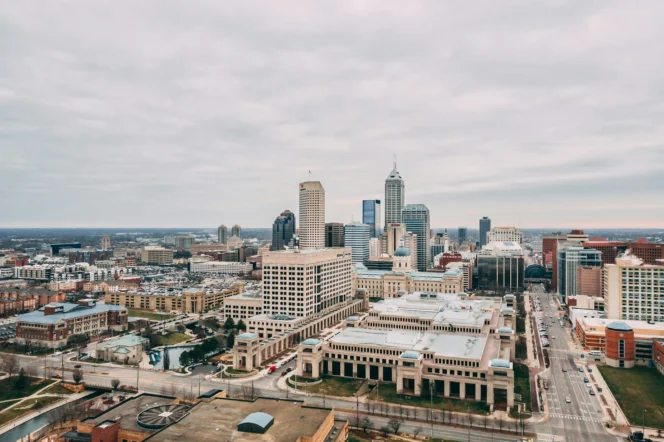
Indianapolis metro (including Carmel and Fishers). The state’s largest market, with an actively redeveloping downtown, convention-driven hotel demand and life-sciences activity. Adaptive reuse and hospitality dominate the transitional pipeline; logistics dominates new construction.
Fort Wayne. Manufacturing and distribution demand at a low basis with a modest local lender pool.
Northwest Indiana (Lake and Porter Counties). Effectively part of the Chicago industrial market at Indiana cost and tax basis, with heavy warehouse demand and borrowers frequently based in Illinois — a common out-of-state-entity market.
Evansville and Southwest Indiana. Healthcare, manufacturing and river-logistics demand at the state’s lowest basis, with the thinnest lender coverage.
South Bend and North Central Indiana. University-anchored demand plus recreational-vehicle and specialty manufacturing around Elkhart, producing heavily-fitted industrial property with real specificity.
Indiana’s two main bridge scenarios have different exits, and conflating them is how borrowers get caught.
Industrial lease-up. Refinance into permanent debt once the building is leased. The risk is a single-tenant building whose lease is shorter than the permanent lender wants — check the take-out’s lease-term requirement before you sign the tenant.
Adaptive reuse and hotel projects. Two milestones: completion, then stabilisation. On an Indianapolis hotel, post-renovation ramp typically takes longer than construction. Size the reserve for both.
Refinance into SBA 504. For owner-occupied commercial property and owner-operated hotels, bridge-to-504 is a real path, since SBA 504 financing offers long fixed-rate amortisation at roughly 10% equity. Slower — start early.
The Indiana failure mode is a twelve-month bridge on an eighteen-month lease-up, or a reuse project where scope grew after demolition. Build contingency into budget and carry, negotiate extension options, and read our guide to bridge-to-permanent refinancing first.
The best bridge loan lenders in Indiana are constrained by asset class more than by geography. The state’s short-term lending bench is real but narrow in a specific way. Unitas Funding and CPL Investments serve Indiana investors locally, Bridgewell Capital covers Indianapolis, and Lima One and Easy Street Capital bring national scale to residential investment property. Given Indiana’s low basis, a large share of genuine deals belong in that market — and for those, these lenders are the right answer.
What the state lacks is general-purpose commercial bridge capital. If your property is not multifamily or healthcare, is not in Indianapolis, or is mid-transition rather than stabilised, Indiana’s own capacity thins out quickly. Those deals need a direct commercial lender that funds from its own balance sheet, lends across asset classes, sizes to cost rather than trailing income, and has no county or membership test. That is where AVANA Capital lends: commercial bridge from $5 million to $30 million, backed by a joint venture with Oaktree Capital, across Indiana and all 50 states, on 23+ years and $1.7 billion in closed loans.
Explore more market insights