





















Let’s work together to find a solution
Rely on AVANA Capital to help preserve your wealth and create growth for your business.

A small business mortgage works fundamentally differently than institutional CRE financing — the dominant products are SBA 504 and SBA 7(a), government-backed programs designed for exactly this borrower. Conventional bank financing is the alternative, not the default. And the qualifying friction lives in business cash flow validation, not appraised value or property income.
This guide is the small business owner’s playbook: SBA 504 vs. SBA 7(a) vs. conventional bank — when to pick each, what they cost, and what to expect through the process. For the broader business mortgage context, see the business mortgage complete guide.
A small business mortgage finances commercial real estate for a business that meets SBA’s small business definition (net worth under $20 million, average net income under $6.5 million over the last 2 years) and whose business will occupy at least 51% of the building. Deal sizes typically run $500,000 to $5,000,000.
The product universe is narrower than for larger institutional CRE deals. Life insurance companies and CMBS conduits don’t compete in this segment (their economics don’t work below $5M). The active lenders are:
For 60–70% of small business owner-occupied mortgages, SBA 504 is the right path. The structure:
Rates as of May 2026 — verify current quotes before making decisions.
| Piece | % of Project | Source | Rate (May 2026) |
|---|---|---|---|
| First Mortgage | 50% | Bank or non-bank SBA lender | 6.0–7.0%, 10-yr balloon, 25-yr amort |
| CDC Second Mortgage | 40% | Certified Development Company, SBA-backed | 5.5–6.0% fixed, 25-yr fully amortizing |
| Owner Equity | 10% | Cash from business or owner | n/a |
Why SBA 504 dominates small business deals:
Eligibility (besides SBA’s small business definition):
See AVANA’s SBA 504 loan program for the full structure walkthrough.
SBA 7(a) loans up to $5M can fund the building purchase plus working capital, equipment, business acquisition, or even debt refinance — all in one loan. More flexible than 504; costs more.
Use SBA 7(a) when: – Buying the business AND the building together – Buying the building plus financing $300K–$1M of equipment or build-out – Refinancing existing business debt as part of the real estate transaction – Mixed-use-of-proceeds where 504’s real-estate-only structure doesn’t fit
Cost: variable rate at Prime + spread, currently 9.5–10.5% (as of May 2026). Significantly higher than 504’s blended ~6.3% but reasonable for the structural flexibility.
When SBA doesn’t fit — special-use property, deal too large for SBA practical limits, borrower prefers no SBA paperwork — conventional bank financing is the path. Community banks and credit unions compete hard in the small business segment.
Rates as of May 2026 — verify current quotes with lenders.
| Feature | Conventional Small Business Mortgage |
|---|---|
| Rate | 6.0–7.5% on 5/7/10-yr fixed |
| Down Payment | 20–25% (75–80% LTV) |
| Term | 5/7/10-year balloon |
| Amortization | 20–25 years |
| Recourse | Full personal guaranty required |
| Best Fit | Existing banking relationship, deals over $5M, special-use properties |
The single largest pricing lever at small business banks: deposit relationships. A $250K–$1M deposit relationship at a CRE-active community bank typically buys 25–50 basis points off the rate sheet. Moving operating accounts to the lender bank before applying is a standard optimization.
A 9-year-old restaurant operating out of leased space buys the building they’ve been renting:
SBA 504 structure: – First mortgage: $600,000 at 6.75%, 10-yr term, 25-yr amort = ~$4,144/mo – CDC second mortgage: $480,000 at 5.85%, 25-yr fixed = ~$3,032/mo – Owner equity: $120,000 cash to close
Monthly debt service: $4,144 + $3,032 = $7,176 ($86,112/yr)
Global DSCR: $245,000 ÷ $86,112 = 2.85x — well above SBA’s 1.15x global minimum. Qualifies easily.
Compared to renting: same building at $9,500/month under a 4% escalation lease = $114,000/yr year 1, $158,000/yr year 10. Mortgage saves ~$28K/yr starting day one and accelerates over time as rent escalates and mortgage stays fixed.
Compared to conventional bank: bank would require $300,000 down (25%) vs. SBA 504’s $120,000 — keeping $180,000 cash in the business that otherwise would have been tied up in real estate equity.
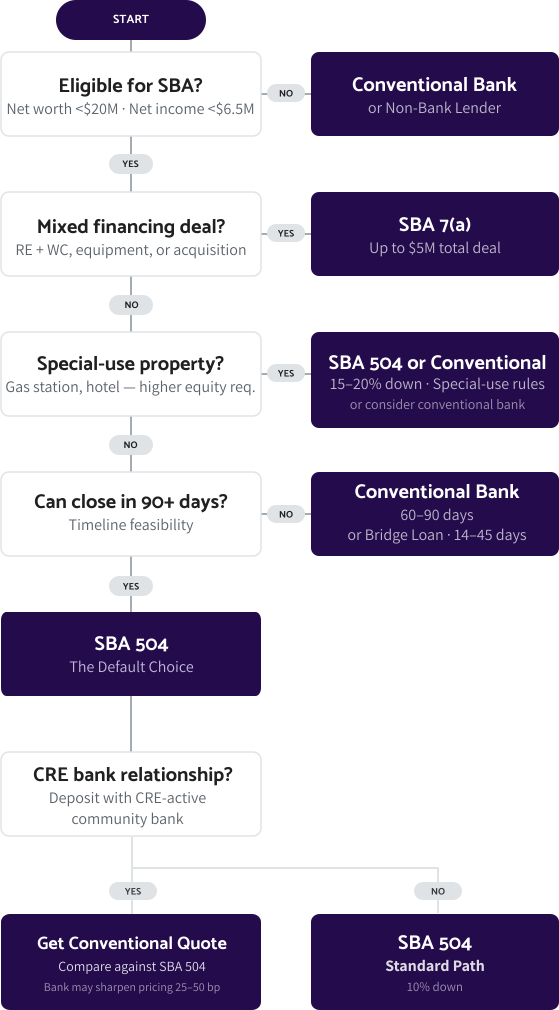
A practical decision framework:
Small business mortgage qualification is structurally similar to larger CRE loans but with three key differences:
1. Global Cash Flow Dominates. Lenders evaluate the business’s net income PLUS the principal owner’s personal income against the proposed debt service. A small business with $200K business net income and $150K principal salary has $350K of global cash flow to support debt service — much better than just looking at business numbers alone.
2. Personal Credit Matters More. The business principal’s personal FICO score directly affects approval and pricing. SBA requires 680+ plus character review; conventional banks similar. Bridge lenders flexible to 620.
3. Personal Guaranty Always Required. Unlike larger institutional CRE deals where non-recourse is common, small business mortgages always require personal guaranties from the principal owners. This is the structural feature that lets lenders underwrite the borrower’s broader financial profile, not just the business entity.
For the broader qualifying framework, see the commercial real estate loan requirements guide.
Small business mortgage timelines by lender category:
| Path | Typical Timeline | Notes |
|---|---|---|
| SBA 504 | 90–150 days | CDC + first lender + SBA coordination |
| SBA 7(a) | 60–120 days | Variable, depending on use of proceeds complexity |
| Conventional Bank | 60–90 days | Faster than SBA but smaller down-payment advantage |
| Community Bank with Existing Relationship | 60–75 days | Streamlined for relationship borrowers |
| Bridge | 14–45 days | Time-sensitive only; high rate cost |
The single best predictor of fast closing is a complete deal package at application. Borrowers who chase missing documents during underwriting routinely add 2–4 weeks to the timeline. For the full process workflow, see the commercial real estate loan process guide.
Small business mortgages live in a narrower lender universe than larger CRE deals. SBA 504 dominates because of its structural 10% down advantage and 25-year fixed CDC piece. SBA 7(a) covers the mixed-use-of-proceeds deals. Conventional bank fills the remaining cases (deal too large, special-use, no SBA fit).
The default playbook for owner-occupied small business CRE acquisition: SBA 504. The single most expensive mistake is defaulting to conventional bank financing when SBA 504 would have worked — on a typical $1.5M deal, that’s $225K of unnecessary cash equity tied up in real estate that could otherwise fund business growth.
AVANA Capital is a direct SBA 504 lender originating nationally. For a competitive quote on a small business mortgage, submit your deal for review.
Explore more market insights