










Let’s work together to find a solution
Rely on AVANA Capital to help preserve your wealth and create growth for your business.

A small business real estate loan is the financing category where SBA programs dominate — SBA 504 and SBA 7(a) together cover 60%+ of small business commercial real estate financing — and where the lender pool is structurally narrower than for larger institutional deals. Life insurance companies and CMBS conduits don’t compete here. Deal sizes typically run $500K–$5M.
This guide is the small-business-specific playbook. The right products, the qualifying differences from larger deals, worked examples on $750K / $1.5M / $3M acquisitions, and what to do when the bank says no.
For the broader business mortgage context, see the business mortgage complete guide for business owners.
A small business real estate loan finances commercial property acquisition or refinancing where the borrowing business meets SBA’s small business definition: net worth under $20 million and average net income under $6.5 million over the prior two years (these are the SBA 504 program eligibility thresholds). In practice, deal sizes typically run $500,000 to $5,000,000.
The structural difference from larger CRE deals:
For most small business owner-occupied real estate acquisitions, SBA 504 is the right answer.
Rates as of May 2026 — verify current quotes with lenders before making decisions.
Structure: 50% first mortgage (bank or non-bank SBA lender, 6.0–7.0% rate) + 40% CDC second mortgage (SBA-backed, 5.5–6.0% fixed 25 years) + 10% borrower equity.
Why it wins for small business: – 10% down payment is the lowest in any commercial real estate financing – 25-year fixed CDC piece locks the largest chunk of the loan – Blended rate of ~6.3% (May 2026) beats every other owner-occupied alternative – SBA guaranty makes underwriting more forgiving on global cash flow
Eligibility: – Owner-occupied (51%+ business occupancy) – For-profit business, US-based – Net worth under $20M – Average net income under $6.5M (over last 2 years) – Business demonstrates ability to repay from operations
See AVANA’s SBA 504 loan program for the full structure.
SBA 7(a) loans up to $5M can fund real estate alongside working capital, equipment, business acquisition, or refinancing existing business debt. More flexible than 504; costs more (variable rate Prime + spread, currently 9.5–10.5% as of May 2026).
Best fit for small business: – Mixed-use-of-proceeds deals (CRE + equipment + working capital in one loan) – Acquisitions where the buyer is taking over an operating business + the building – Total deal size under $5M
For pure real estate financing under $5M, SBA 504 typically beats 7(a) on rate by 200+ basis points. Use 7(a) when you need the use-of-proceeds flexibility.
Local community banks and credit unions can be highly competitive on small business commercial real estate financing. Deal economics favor banks at:
Rates as of May 2026 — verify current quotes with lenders.
| Feature | Community Bank Conventional |
|---|---|
| Rate (May 2026) | 6.0% – 7.5% |
| Down Payment | 20–25% |
| Term | 5/7/10-year balloon |
| Amortization | 20–25 years |
| Recourse | Personal guaranty required |
| Best Fit | Established business with deposit relationships |
The single biggest pricing lever at small business banks: deposit relationships. A $250K–$1M deposit relationship at a CRE-active community bank typically buys 25–50 basis points off the rate quote.
Specialty non-bank lenders (like AVANA) that originate SBA 504 first mortgages and SBA 7(a) loans nationally. The advantage over local banks: deeper SBA expertise, faster closing, and access to lenders that fund nationally regardless of CDC location.
For the broader breakdown of lender categories, see eight types of commercial real estate loan companies.
A 12-year-old medical practice buys a 4,500 sq ft medical office condominium for $750,000. Practice will occupy 100% of the building. Annual practice net income $385,000.
| Piece | % | Amount | Term | Rate | Monthly P&I |
|---|---|---|---|---|---|
| First Mortgage | 50% | $375,000 | 10-yr term, 25-yr amort | 6.75% | $2,590 |
| CDC Second | 40% | $300,000 | 25-yr fixed | 5.85% | $1,895 |
| Borrower Equity | 10% | $75,000 | n/a | n/a | n/a |
Rates illustrative as of May 2026 — verify current CDC debenture and first mortgage rates before application.
Monthly debt service: $2,590 + $1,895 = $4,485 ($53,820/yr) Practice global DSCR: $385,000 ÷ $53,820 = 7.15x — far above the SBA 1.15x global minimum, qualifies easily for best-in-class pricing.
Vs. renting equivalent space at $4,200/month under a 3% escalation lease: ownership saves cumulative $185K over 10 years AND builds $300K+ of equity.
A restaurant operator acquires the building they’ve been leasing for 8 years ($1.2M) plus $200K of FF&E refresh + $100K of working capital. Total deal: $1.5M.
SBA 504 doesn’t fit because of the working capital component. SBA 7(a) covers all three needs in one loan.
Higher rate than SBA 504 would be, but the structural ability to roll FF&E and working capital into the real estate loan eliminates the need for separate equipment financing or a line of credit — simplifying the capital stack.
A 20-year-old manufacturing business with $4.5M in existing deposits at a regional bank buys a $3M industrial building. The bank competes hard for this deal because of the existing relationship.
Higher down payment than SBA 504 would require ($750K vs. $300K), but the borrower has the cash and prefers the simpler bank documentation + faster closing (60–75 days vs. 90–120 days for SBA 504).
The seven qualifying dimensions, with small-business-specific notes:
| Requirement | What Small Business Lenders Check | Typical Threshold |
|---|---|---|
| Personal Credit (principals) | FICO of business owners | 680+ (SBA, bank); 700+ rarely needed |
| Business Operating History | Years operating as a viable entity | 2+ years; some lenders allow 1 year for strong cash flow |
| Global Cash Flow (DSCR) | Business NOI + principal personal income | 1.15x global (SBA); 1.20–1.25x (conventional bank) |
| Down Payment / Equity | Cash to close from non-borrowed sources | 10% (SBA 504); 20–25% (bank) |
| Owner-Occupancy | Business occupies 51%+ of building | Required for SBA; preferred for bank |
| Liquidity Reserves | Cash post-close to cover debt service | 6 months DS minimum; 9–12 mo preferred |
| Personal Guaranty | Owner agrees to personally back loan | Required on SBA + most owner-occupied bank loans |
The two qualifying dimensions where small business borrowers most often hit friction:
1. Global cash flow stress. If business net income is volatile or the business is in a growth phase with thin margins, lenders may decline. Mitigation: extend the lookback to demonstrate stability, document growth trajectory, or bring co-borrower or guarantor financial strength.
2. Down payment source. The SBA requires down payment to come from non-borrowed sources. Loans from friends, family, or business credit lines for the down payment are restricted. Cash, savings, sale of other business assets, or principal personal funds are acceptable.
For the full diagnostic on requirements, see the commercial real estate loan requirements guide.
A practical decision tree:
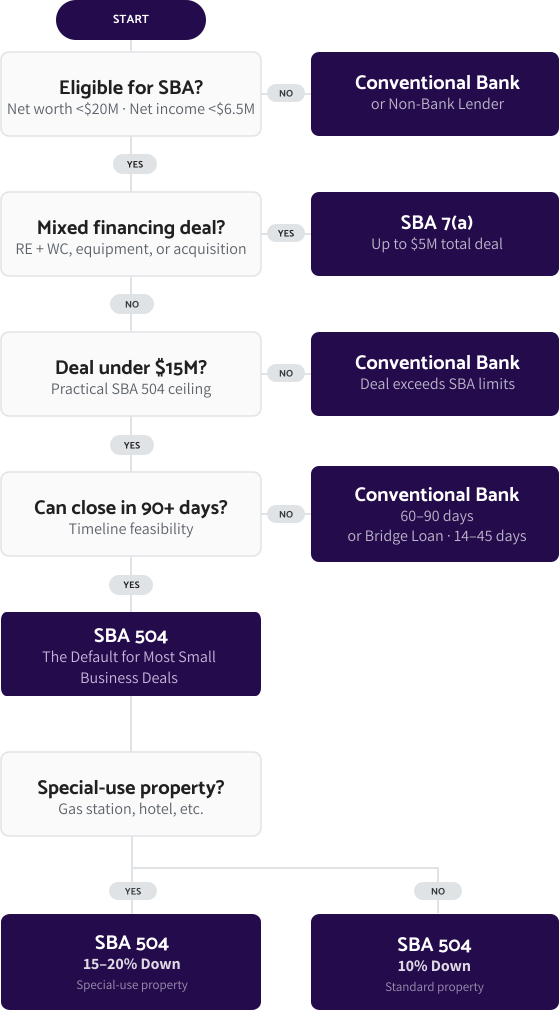
For 70%+ of small business commercial real estate acquisitions, this tree lands on SBA 504. The remaining 30% land on conventional bank (deal-size, special use, timing) or SBA 7(a) (mixed-use-of-proceeds).
Four mistakes consistently cost small business borrowers:
Defaulting to the local bank without considering SBA 504. Local banks rarely originate SBA 504 first mortgages — they prefer conventional loans they fully control. A business that takes the bank’s 25%-down conventional offer when SBA 504’s 10% down would have worked is leaving $150K+ of cash on the table on a $1M deal.
Mixing SBA 504 vs. 7(a) wrong. SBA 504 for pure real estate; SBA 7(a) for mixed-use-of-proceeds. Borrowers who run pure real estate through 7(a) overpay 200+ basis points unnecessarily.
Underestimating closing timeline. SBA 504 takes 90–150 days. Telling a seller “I can close in 60 days” with an SBA 504 financing path is a recipe for losing the deal or paying penalty extensions.
Not bringing deposit relationships when going conventional. A community bank conventional loan without an existing deposit tie at the institution typically prices 25–50 bp wider than the same loan with a relationship. Even moving $250K of operating cash to the lender bank can sharpen the quote.
Small business real estate loans live in a narrower lender universe than larger CRE deals — SBA 504 dominates, SBA 7(a) covers the mixed-use cases, and conventional banks fill the remainder. The default playbook for owner-occupied small business CRE is SBA 504 at 10% down with a 25-year fixed CDC piece — the lowest blended cost of capital available for owner-occupied commercial real estate at any deal size.
The single most expensive mistake is defaulting to conventional bank financing when SBA 504 would have worked. On a $2M deal, that’s $200K of unnecessary cash equity locked into the property — capital that could otherwise fund business growth.
Explore more market insights